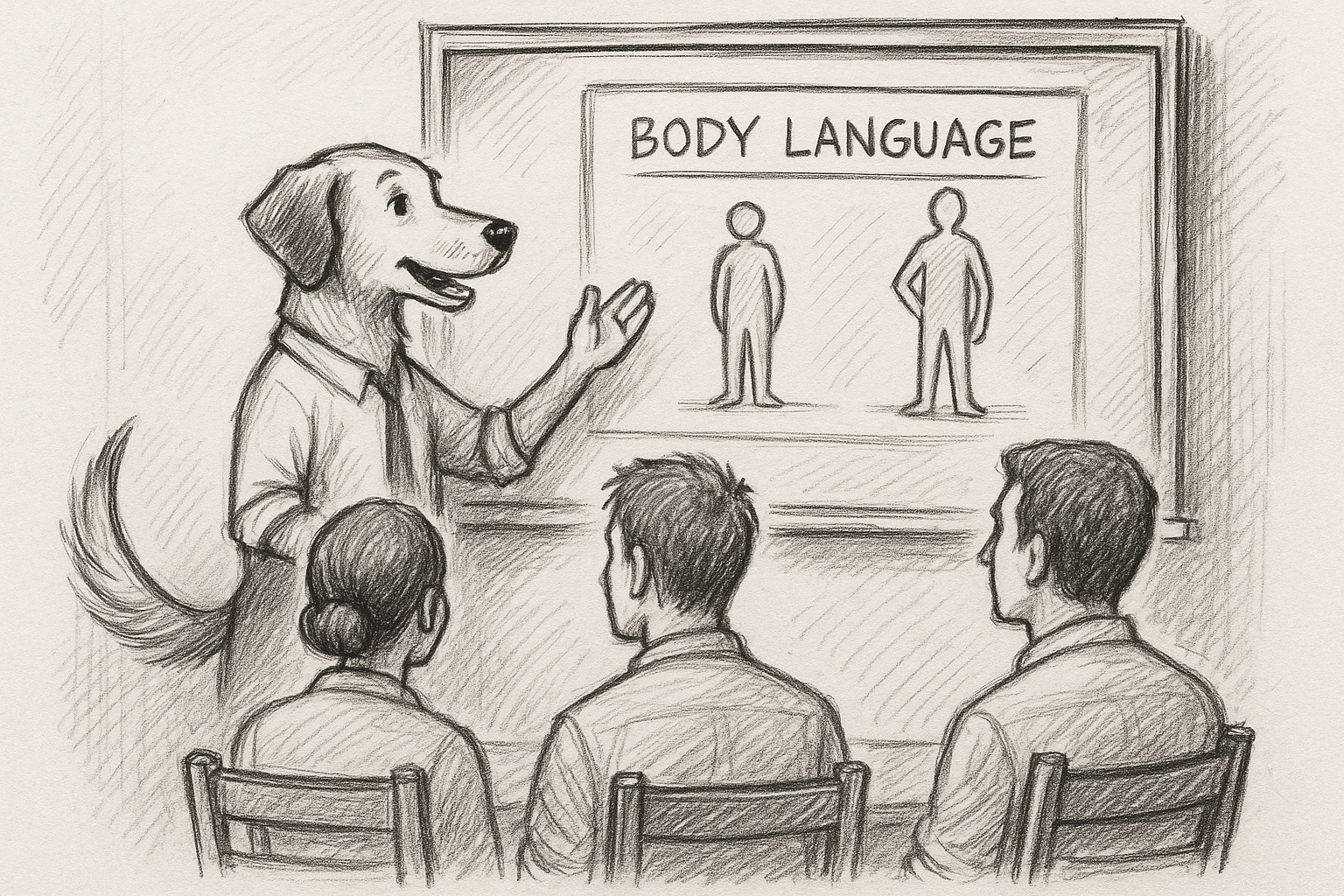
In dog training, most of our energy goes into teaching the animal: sit when I say sit, come when I call, heel when I walk. We pride ourselves on clarity, timing, and reinforcement schedules. But too often, this work happens in only one direction, shaping the dog to understand us.
The overlooked half of the equation is teaching the human to communicate in ways that dogs already understand.
The Limits of Human Language
Dogs don’t grow up steeped in human grammar. They don’t parse sentences or debate semantics. Their world is rhythm, tone, posture, space. A dog reads hesitation in your step long before they parse the word “stay.” They feel safety or pressure in the way you carry yourself more than in the syllables you repeat.
When a trainer only sharpens the dog’s ability to decode human signals, progress is slow and fragile. The dog is constantly translating across species. There is real value in helping the dog learn our cues, but progress multiplies when the human meets the dog partway in their own language.
Becoming More Dog-Like
This doesn’t mean barking at our clients or asking them to crawl on all fours. It means teaching them to:
- Use consistent body language that matches their intent.
- Set rhythms and patterns that give the dog clarity.
- Hold boundaries in a calm, grounded way instead of through tension or repetition.
- Convey safety and leadership through tone, timing, and presence.
In short, to act in ways that feel natural to a dog.
Training as Translation
The real work of a trainer is not simply to act as a translator between species, but to teach the human to become bilingual. When a person learns to move, speak, and structure interaction in dog-like ways, their cues require less effort, less rehearsal, less correction. The relationship itself becomes the training ground.
The Measure of Success
A well-trained dog is not just one that obeys human words. It is one that responds effortlessly to the human’s way of being, because the human has learned to be a little more dog.
As trainers, the more we help people shift into this state, the less they need us, and the more harmonious their daily lives become. That is the mark of lasting success.
Tyler Muto
Click here to schedule a FREE Discovery Call and learn how my mentorship programs can elevate your training and set you apart from the crowd
Leave a Reply