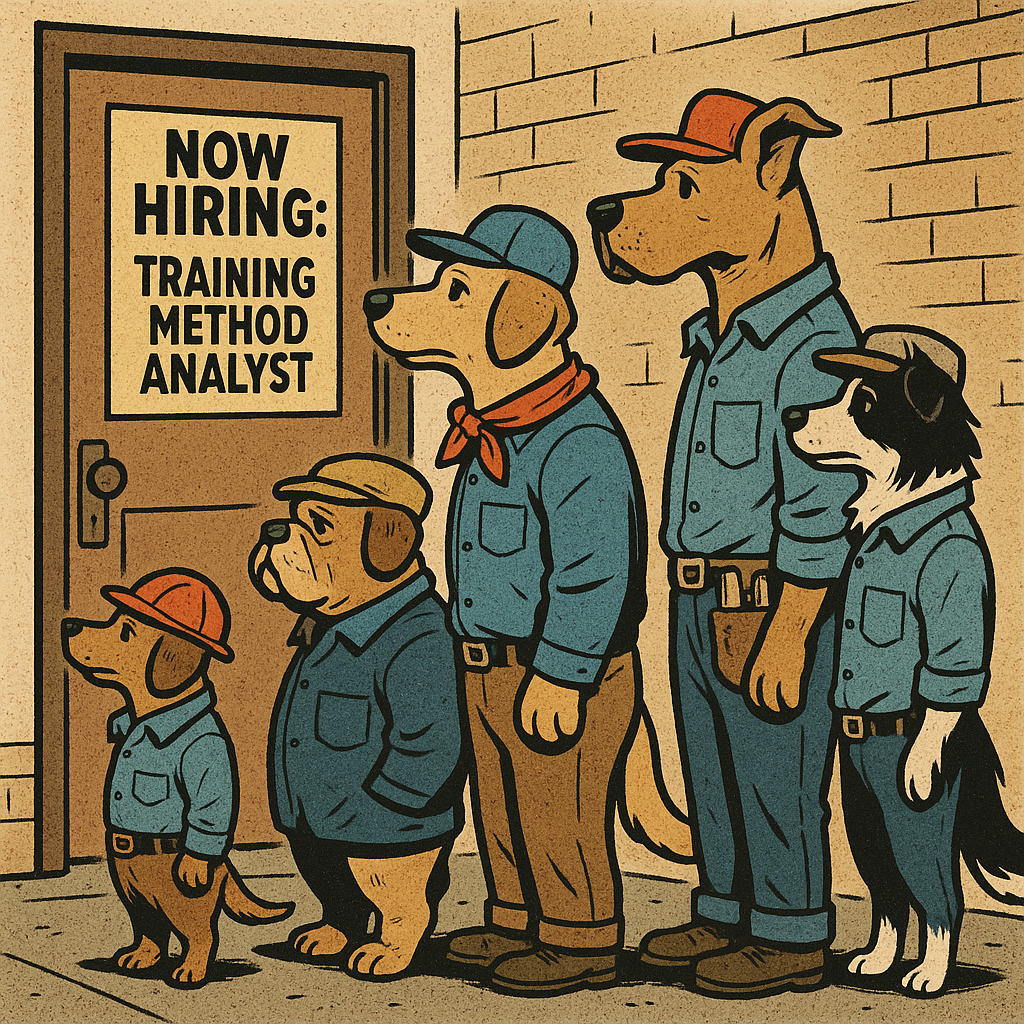
What if the strength of our profession isn’t found in one right way, but in the space we make for many?
In the dog training world, disagreement is almost a sport.
We debate methods, argue over terminology, and dissect the smallest differences in philosophy. Yet beneath all that noise, most of us share a single intention: to improve the quality of life for dogs and the people who love them.
That shared purpose is our common ground, and it’s worth protecting.
When Too Many Ideas Become a Barrier
A client recently voiced a concern that is quite common among the dog trainers that I work with.
She told me she was experiencing analysis paralysis. She had been studying multiple training systems, most recently the play-based trend, and while she loved the theory, she felt stuck.
“I enjoy learning about it,” she said, “but my clients can’t relate. It just doesn’t click for them, and I’m struggling to get them to do the work.”
She wasn’t criticizing play-based work; she was naming a truth about learning styles. Even the best-designed system can fail if it doesn’t make sense to the human applying it.
Resonance Is the Gateway to Results
For any method to work, it has to resonate.
People’s brains process information differently. Some thrive on structure and directness. Others are more relational or playful. If a method doesn’t align with how someone naturally learns, they’ll struggle to follow through, no matter how effective that method might be in theory.
That’s why variety in training approaches isn’t a weakness in our field; it’s a strength. Each style speaks to a different kind of learner. For some owners, play-based work is the missing piece that unlocks joy and connection. For others, a more linear or direct process provides the clarity they need to feel confident. For some, reward-only methods align with their values, and for others a balanced approach makes the most sense.
If our goal is to raise the overall standard of life for dogs and families, no single ideology will get us there. It will take a broad spectrum of approaches, enough that every dog owner can find a teacher and a language that fit.
After all, the best medicine is the one you’ll take.
Openness Over Orthodoxy
Breadth of perspective doesn’t mean every trainer should try to master every style. It means recognizing the value in approaches that differ from our own. We can debate ideas without demeaning the people who hold them. We can practice conviction without slipping into dogma.
It also means understanding the role of specialization. Many of the well-known trainers who represent particular methodologies built those reputations over decades. Their current audiences often come pre-aligned with their philosophy and teaching style. But early in their careers, they worked with a broader public, clients who didn’t always share their outlook.
At some point, every trainer faces a choice:
Do I adapt my approach to fit the client in front of me, or do I invite clients into the approach that fits me?
Neither choice is more noble. What matters is making it consciously, with eyes open to the trade-offs, rather than reacting from frustration or ego.
A Profession Made Stronger by Difference
A field with only one “correct” ideology is brittle. A field that welcomes variety of ideas, methods, and communication styles is resilient.
This line of thinking was part of my inspiration when I created Consider the Dog back in 2018. I didn’t want a platform that only showcased my own work. I wanted a space where different trainers, some with perspectives quite unlike mine, could share their approaches side by side.
Because when dog owners see multiple paths toward better relationships with their dogs, the entire community benefits.
The more space we make for different kinds of trainers, the more dogs and families we can help.
In an industry that often mirrors the polarization of the world around it, if we truly care about the wellbeing of dogs, we need to celebrate our differences, not argue about them.
Our work grows stronger when we allow difference to sharpen, not divide us, when we treat every thoughtful approach as part of a larger conversation about how to help dogs live better lives.

Leave a Reply