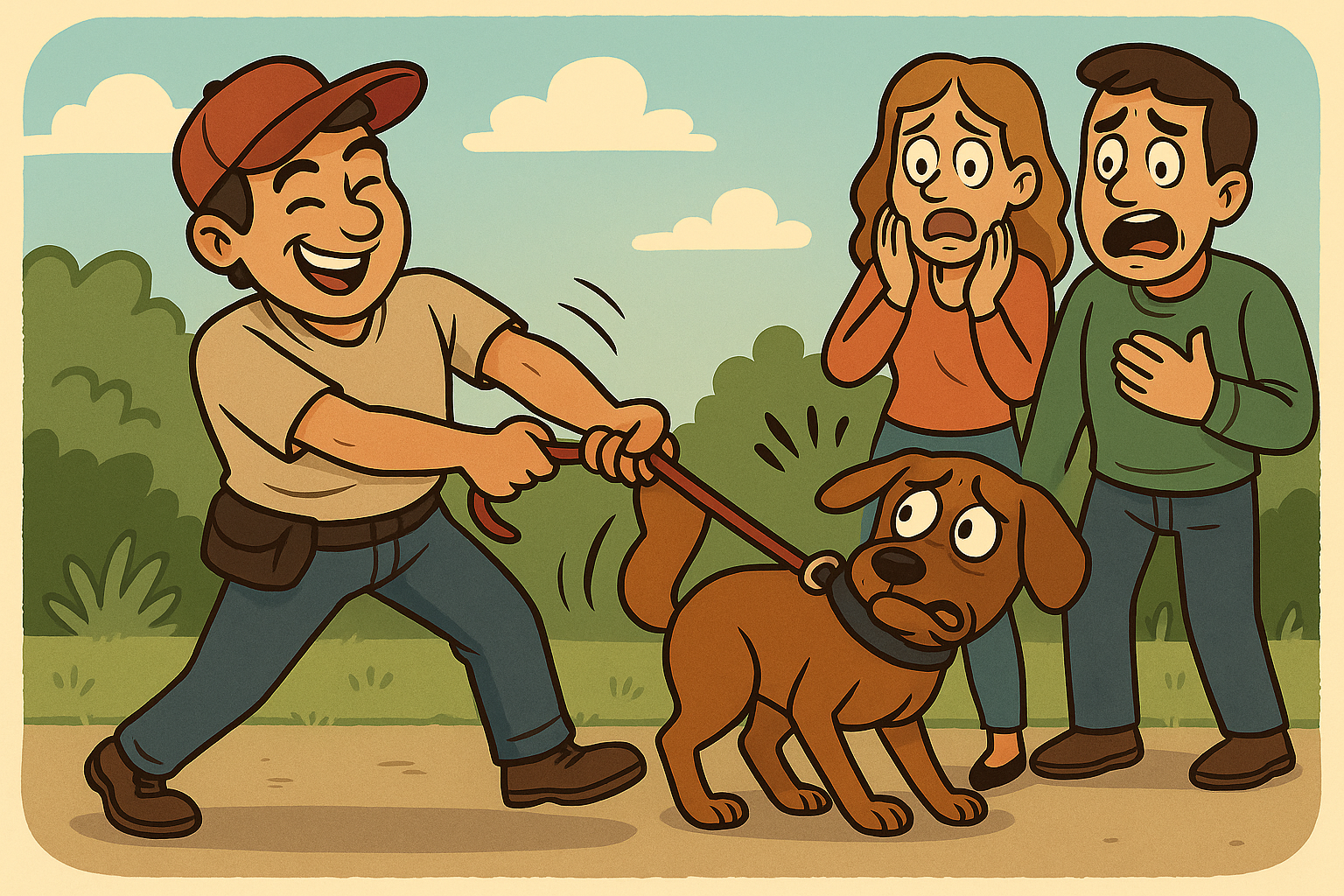
In dog training, punishment is a loaded word. For many owners – and even for some professionals – it carries an emotional weight that is hard to ignore. And maybe that’s the point.
Too often, trainers try to strip away that emotion. A client hesitates to correct their dog, and the standard response is: “Don’t feel bad – it’s for their own good.” The logic seems sound. But in practice, this reassurance often falls flat. Instead of resolving the discomfort, it creates distance: the trainer appears detached, while the owner feels dismissed.
What if the opposite approach is better? What if clients should feel bad about punishment – and what if we, as professionals, should too?
Validating the Client’s Experience
When an owner admits that correcting their dog feels uncomfortable, our instinct is often to fix the feeling. But what if we leaned into it instead?
It is normal to feel bad about punishing a dog. In fact, it would be odd – perhaps even troubling – if someone felt nothing at all. By acknowledging that discomfort as healthy, we validate the client’s emotional experience rather than negating it.
This validation opens a door. We can reframe their unease as a shared commitment:
- Because punishment feels serious, we will treat it seriously.
- Because it makes us uncomfortable, we will be careful, deliberate, and conscientious in how we apply it.
- Because it matters, we will always look for ways to minimize its necessity.
Instead of fighting the emotion, we harness it. The discomfort becomes a safeguard against carelessness. And importantly, this shift in framing not only increases the likelihood that clients will use corrections more consistently and effectively – it also strengthens rapport between trainer and client. By affirming a shared view of punishment as serious and weighty, we build trust and alignment, making the training process feel less like a tug-of-war and more like a true partnership.
The Professional’s Risk: Numbness
Clients wrestle with guilt; trainers wrestle with the opposite problem. Over time, professionals can become numb to the emotional weight of punishment. And numbness is dangerous.
Erosion of standards.
When we stop feeling the gravity of punishment, we lose the natural motivation to refine our craft. My own development as a trainer has revolved around finding ways to use punishment less often, with less intensity, while still improving clarity and outcomes for both dogs and their owners. That pursuit didn’t just sharpen my skills – it drove much of the innovation that ultimately elevated my work to the world stage and shaped the way others think about training. And it’s the same ongoing pursuit that every trainer should embrace: a commitment to continually refining skills so that our methods grow lighter, clearer, and more effective over time.
Erosion of meaning.
Desensitization doesn’t just affect how we train – it affects who we are in the work. When the emotional weight of punishment fades, so too can the sense of purpose that first drew us to this profession. Over time, that numbness can bleed into everything: the spark of curiosity, the joy of breakthroughs, even the empathy that made us choose this path in the first place. Many trainers describe it as burnout, but at its core it is often a loss of connection – a slow drift away from the meaning that once made the hard days worthwhile.
Holding on to the Discomfort
Punishment is not something to wield casually. Nor is it something to ignore in theory while normalizing in practice. Its seriousness is what keeps us careful, humble, and creative.
Clients should feel bad about using punishment. Trainers should too. Not because punishment is always wrong, but because feeling bad is a sign of conscience. And conscience – tempered by skill, clarity, and responsibility – is what separates thoughtful training from careless compulsion.
The goal isn’t to erase discomfort. The goal is to use it well.
-Tyler Muto
Click here to schedule a FREE Discovery Call and learn how my mentorship programs can elevate your training and set you apart from the crowd.
Leave a Reply